Peter Bracke
Rorschach of Reflections
Peter Bracke
The exhibition
Two forms of sacrality in dialogue: the Amazon rainforest and a religious architectural space.
Conceived for the Chiesetta della Misericordia in Venice, the exhibition brings into dialogue two forms of sacrality: that of the Amazon rainforest and that of a religious architectural space. It examines how different sacred systems attribute presence and spiritual force to places, and how these perceptions can resonate within a shared spatial setting.
Together, image, video and sound seek to suspend familiar representations of the tropical landscape. The rainforest is not presented as an object to be observed, but as a sensory field to be entered, where meaning arises in the moment of perception and sacrality is experienced as presence rather than depiction.
The works are installed in the large central altar niche and in the two lateral niches beside the existing mosaics, creating a direct dialogue with the church’s architectural and iconographic framework. A vertical video installation and a composed soundscape complete the space.
Watch the introduction film — 6′45″, directed and edited by Ruth Verstraeten
The photographic works
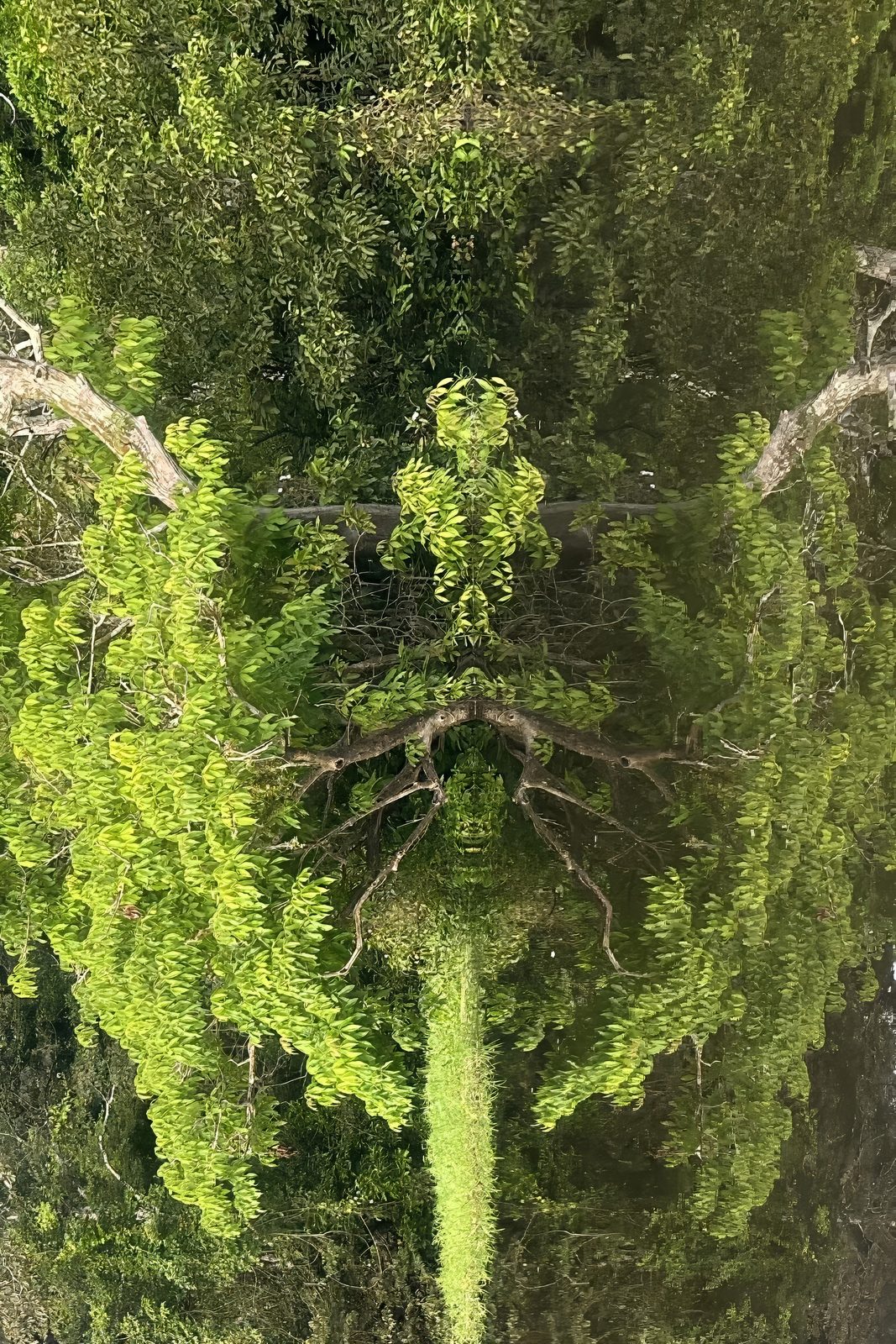
Plates I — X. The rainforest, mirrored along its central axis, opens like a Rorschach plate.
At the centre of the exhibition are vertically oriented photographic works based on reflection. By mirroring the rainforest along a central axis, the images evoke Rorschach-like forms that invite intuitive and subjective reading. Faces, animals, insects and hybrid figures appear, reflecting worldviews in which the forest is understood not as inert matter but as a living entity endowed with presence and agency.
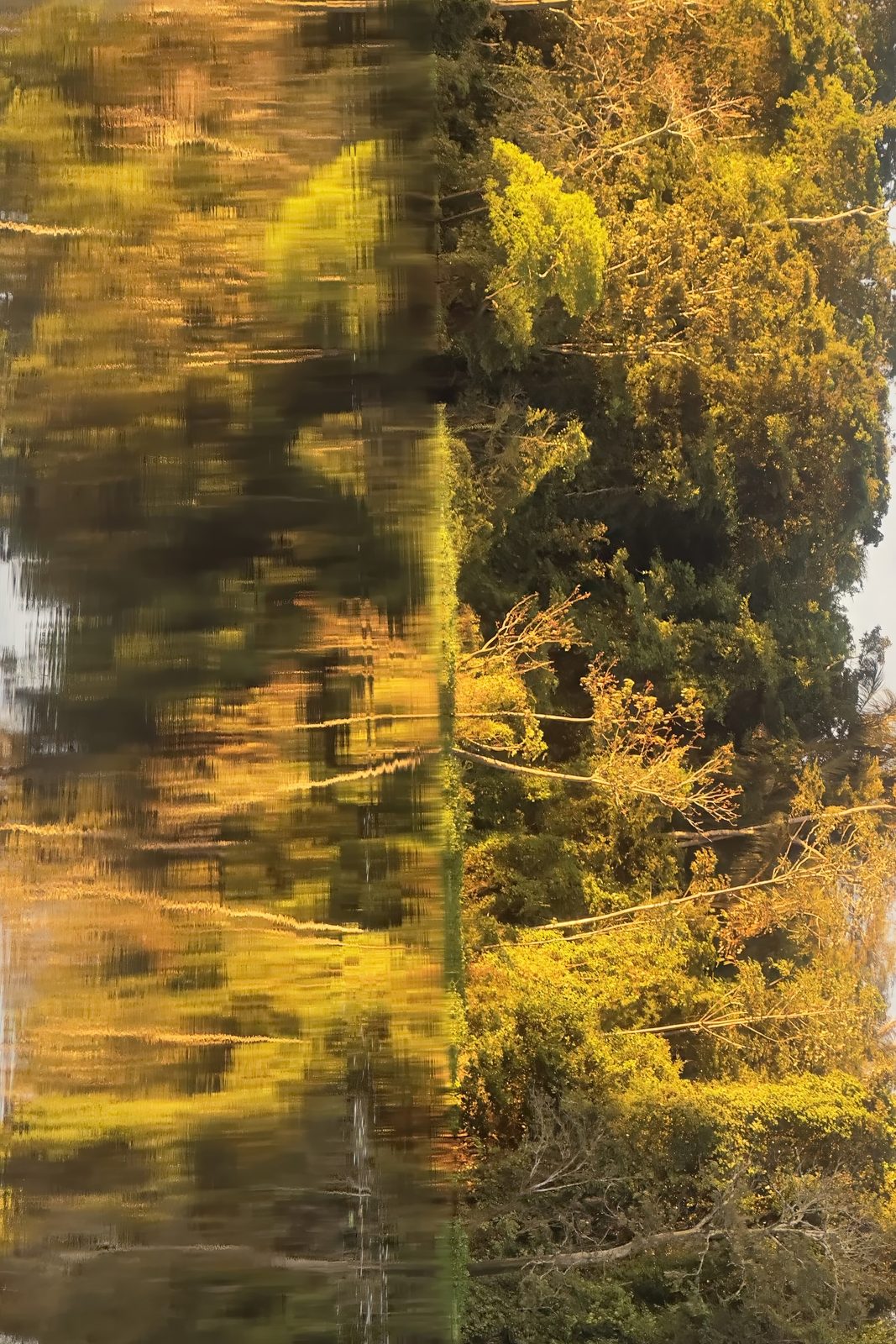
The photographs were made in the flooded forests of the Brazilian Amazon — the várzea around Tefé and the Mamirauá Reserve, and the Rio Azul, in the states of Amazonas and Pará — where a still water surface folds the landscape into near-perfect symmetry.
Scroll sideways · click a plate to enlarge
Plates I — X are also available as editions
Essay
In the mirrored waters of the Amazon, the act of seeing becomes reciprocal. The forest does not merely reflect — it observes itself. What was once horizontal becomes vertical; what was landscape turns into axis. The moment of vision is suspended between river and sky, between the real and its double.
At first glance, the scene seems natural — trees rising against a luminous sky. Yet as the gaze adjusts, the certainty of orientation collapses. Is the image upright or inverted? Are we looking at the forest or its reflection? The instability of perspective pulls the spectator into a quiet disorientation, as if the forest itself were deciding how to be seen.
In this hesitation, a third space appears — neither the image of nature nor its mirror, but their convergence. Two forests meet face to face, the one becoming the apparition of the other. What unfolds is not illusion but construction: an encounter of eye, lens and environment that generates a new perceptive field. The image, rather than representing the forest, becomes its continuation, an act through which nature invents its own vision.
Thus, what is seen, when it is seen, is not offered by the landscape alone. It arises from the interplay between the photographer, the apparatus, and the living density of the forest — a choreography of perception where object, subject and instrument merge. The reflection is not repetition but genesis: a forest constructing its own gaze.
The Chiesetta
Installation views — Chiesetta della Misericordia, Campo de l’Abazia, Cannaregio.
The Chiesetta della Misericordia is a small deconsecrated church on the Campo de l’Abazia in Cannaregio, beside the Scuola Vecchia della Misericordia. Its central altar and two lateral niches, framed by marble, with the surviving mosaics in the remaining niches, set the measure for the works: each plate takes the place an altarpiece once held. Two further works, printed on glass, sit in the former wall openings; a vertical screen stands in the nave.
The video installation
Filmed horizontally, presented vertically: time and motion enter the reflective structure.
The visual logic of the plates continues in a video installation. Filmed horizontally but presented vertically, the moving image disrupts orientation and introduces time and motion into the reflective structure. The image shifts between sky and water, landscape and apparition, generating a perceptual space in which the forest seems to observe itself, extending its logic of reflection and transformation.
Video: Peter Bracke · video editing: Ron Chiers. Three excerpts from the moving image, shown upright as in the Chiesetta:
The full film
The complete video installation — 9′57″ — with the soundscape by Peter Bracke and Antoon Jaminé.
Sound on; full screen recommended.
Introduction film
Peter Bracke on the work, the forest and the church — a film by Ruth Verstraeten.
Made ahead of the exhibition: on the origins of the work in the flooded forests of the Amazon, the mirrored image and the Rorschach plate, and what the Chiesetta della Misericordia would make possible. 6′45″, in English.
Direction and editing: Ruth Verstraeten.
Sound
Rainforest and ritual acoustics, composed into one spatial medium.
Sound plays a structuring role throughout the exhibition. Composed from recordings made in both rainforest and religious contexts, the soundscape combines natural and ritual acoustics. Rather than illustrating the images, sound functions as a spatial medium, immersing the visitor and reinforcing a shared sense of sacral presence.
Soundscape: Peter Bracke and Antoon Jaminé. The full seventeen-minute composition that filled the Chiesetta can be heard here.
A third way of seeing
Seen from a narrow river channel, the forest rises to an improbable height against the sky. The spectator hesitates: is the image upright or inverted? Focus on the luminous background and the sky darkens into a distant waterway; focus on the greens and the trunks hurtle upward, narrowing the air into a tunnel.
Neither reading prevails. What presents itself is a third way of seeing, in which nature and artifice are convened to produce an impression of immensity. What is seen is neither given by the environment nor simply imagined: it arises where perception is displaced by perspective.
Every spectator arrives with a ready-made image of the tropical forest — an idea so widely circulated it has become almost cliché. One way of undoing the stereotype is to ask what unique image was formed in the very moment when it was seen.
Freely adapted from Laymert Garcia dos Santos, in Claudia Jaguaribe, Quando Eu Vi (2009).
Origins
Where the images were born: the flooded forests of Amazonas and Pará.
The photographs and film were made on the waterways near Tefé and in the Mamirauá Sustainable Development Reserve, and on the Rio Azul. For part of each year the várzea stands in the river: the forest floods, the canopy doubles in the still water, and the boat moves between two skies. The plates were shot from a narrow channel, at first light, looking straight into that doubled forest.
With the local guides Florisvaldo Ferreira Rocha and Isac Machado da Silva.
Making of
From the print studio to the altar niche — and back down the canal.
The plates were printed at large format by Solution in Belgium on 7 July 2026, brought to Cannaregio by boat and installed in the niches of the Chiesetta in the days before the opening on 29 July. On 31 August, the morning after the last visitors, the works came down again the same way.
Printing the plates — Solution, Belgium — July
De-installation — 31 August

The book
The first photo book: plates I — X, the essays and the installation views.
Liturgia da Floresta Encantada — Rorschach of Reflections was published on the occasion of the exhibition. It gathers the ten plates, the essays When the Image Saw Itself and A Third Way of Seeing, and the views of the Chiesetta.
Editions
The plates exist beyond the Chiesetta — as large-format works for a wall of one’s own.
Each of the ten plates is available as a signed and numbered edition: a pigment print on Hahnemühle paper, mounted on aluminium Dibond, in a small edition per motif and in two formats. Every work is accompanied by a certificate of authenticity.
Availability, formats and conditions on request — bracke.peter@gmail.com.
Interior studies (visualisations) — Andrea Zampol D’Ortia, 2026
The exhibition — 2026
About the artist
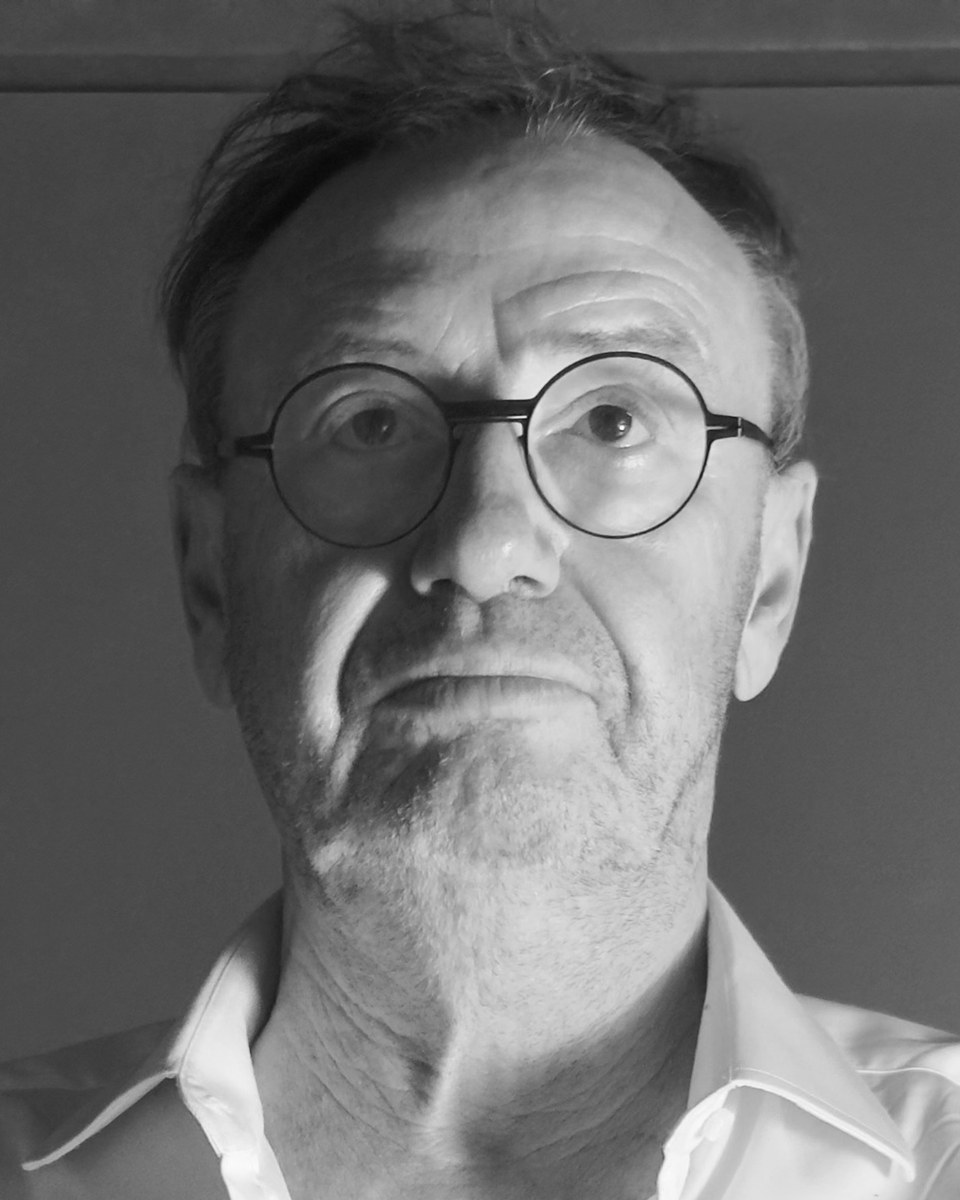
Peter Bracke works at the intersection of photography and installation.
Peter Bracke (b. 1957, Belgium) works at the intersection of photography and installation. His practice is rooted in an intuitive engagement with the natural world, developed into conceptual spatial works combining image, material and environment. He pursued formal training in Foto-kunst at the Academie, Ghent, and co-founded the artist collective FaceOff in 2006. His work has been exhibited internationally across Europe, with a sustained presence in Italy — including Palazzo Mora, Venice (2019, 2024), Museo Civico Treviso (2023) and Fotofever, Carrousel du Louvre, Paris (2019).